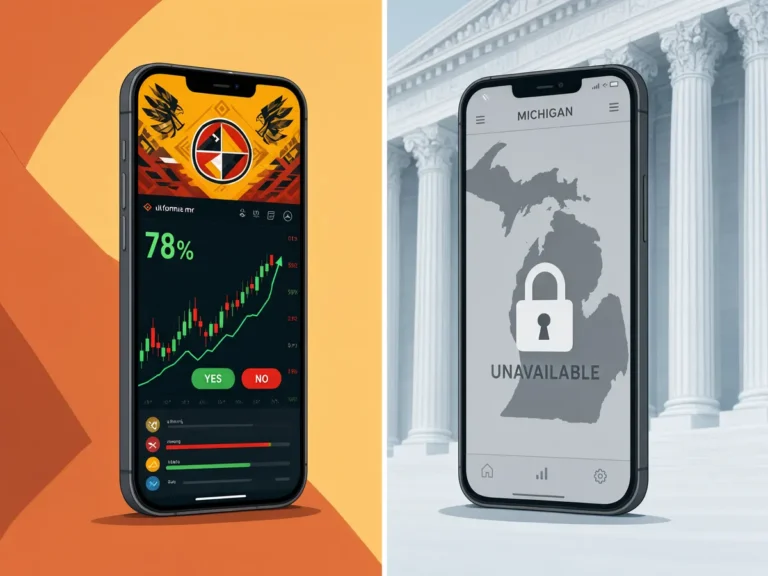
Is buying a contract on tonight’s game really different from betting on it? Michigan’s gaming regulator says no, and Coinbase has now stopped arguing the point. The Michigan Gaming Control Board announced that Coinbase Financial Markets agreed to stop offering new sports-related event contracts to Michigan customers as of October 10, and to close out any remaining open customer positions by that same deadline. Coinbase sports prediction markets, in that state at least, are finished.
The stipulation covers contracts traded on KalshiEX and other designated contract markets, not just anything Coinbase built in-house. That detail matters, and I’ll come back to it. First, the pile of comfortable assumptions this agreement flattens.
Myth: a prediction market isn’t gambling, it’s trading
This is the load-bearing claim of the entire category, and regulators keep refusing to buy it. The MGCB’s framing is blunt: it describes these products as “sports wagering products disguised as federally regulated prediction markets.” Not a grey area in their telling. A disguise.
The logic is hard to dodge. You stake money on whether a sporting event resolves one way or the other. If you’re right you get paid; if you’re wrong the stake is gone. Calling the stake a “position” and the payout a “settlement” doesn’t change the economics, and state gaming statutes were written around the economics, not the vocabulary. Michigan licenses sports wagering. It did not license Coinbase to accept sports wagers. Everything else is detail.
Where prediction markets genuinely differ is price discovery. On an exchange you trade against other participants, and the price moves with order flow rather than being set by a book’s odds compiler. Interesting mechanically. Legally, it hasn’t saved anyone yet.
Myth: a CFTC-registered venue is beyond the reach of state gaming law
This was the whole bet the sector made, and it is now three for three in Michigan going the wrong way. The Coinbase stipulation follows a nearly identical agreement with Robinhood Derivatives, LLC, and a state-court preliminary injunction Michigan obtained against KalshiEX LLC.
Note the pattern. Kalshi fought and got hit with an injunction. Robinhood and Coinbase looked at that and negotiated their way out instead. MGCB Executive Director Henry Williams put the incentive structure plainly: “Operators are halting these activities because they face significant legal consequences for continuing to offer them in our state.”
The broader pre-emption question, whether federal commodities oversight of a designated contract market displaces state gambling licensing, is still being litigated in various places and I’m not going to pretend it’s settled. But there’s a difference between an unresolved legal theory and a usable business position. Two of the biggest consumer trading apps in the United States just decided the theory wasn’t worth defending in Michigan. That’s a verdict of sorts.
Myth: this is a crypto crackdown
Tempting read, wrong read. Robinhood Derivatives isn’t a crypto company, and the sports event contracts in question clear through derivatives infrastructure, not a blockchain. The common thread across all three actions is unlicensed sports wagering, full stop.
That said, there’s a real consequence for crypto sports betting and crypto-adjacent wagering generally. Coinbase is the most mainstream, most compliance-obsessed crypto brand in the US market. When a firm with that risk appetite voluntarily winds down a product line rather than test it in court, every smaller exchange, wallet and app eyeing “event contracts” as a soft entry into sports has to reprice its own legal risk. The signal isn’t “crypto is in trouble.” It’s “the sports wrapper is the trouble, regardless of what rails you run on.”
Myth: crypto infrastructure makes the product hard to switch off
Decentralisation talk collapses the moment a regulator identifies a licensed, named, US-incorporated entity with customers to protect and a reputation to lose. Michigan didn’t need to touch a smart contract. It needed a conversation with Coinbase Financial Markets, which has registrations to keep and a parent company with shareholders.
And the enforcement isn’t just forward-looking. The agreement requires open customer positions to be closed out by the deadline, which is the part traders actually feel. You don’t get to sit on a contract until the season resolves. Your exposure gets unwound on the regulator’s timetable, not yours.
Myth: event contracts are a better deal than a sportsbook
You hear this constantly: no house edge, just a market. The “no house edge” bit is marketing shorthand and it’s misleading.
Exchanges take fees, spreads exist between bid and ask, and thin markets on minor events widen those spreads considerably. The venue’s cut may be structured differently from a sportsbook’s margin, but it’s still a cost you pay on every round trip, and it still makes the average participant’s expected return negative over time. On a two-sided market at 50/50 fair value, the fee is the entire difference between break even and a slow bleed. Transparent pricing is a genuine feature. Free money is not on the menu.
There’s also a consumer protection gap that rarely makes it into the pitch deck.
| Feature | State-licensed sportsbook | Sports event contract venue |
|---|---|---|
| Primary oversight | State gaming regulator (e.g. MGCB) | Federal derivatives framework |
| Responsible gambling tools | Mandated deposit, loss and session limits | Not required by gaming rules |
| Self-exclusion register | State-run, enforced across licensees | Generally outside its scope |
| Complaint route | State regulator handles player disputes | Brokerage and federal channels |
| Cost to the customer | Bookmaker margin built into odds | Fees plus bid/ask spread |
That table is the quiet argument behind prediction market regulation fights. A state that has spent years building self-exclusion lists and advertising rules is not going to shrug while an identical risk product operates next door with none of it.
Myth: it’s a Michigan problem, so it doesn’t concern you
Michigan has now run the same play three times with three different counterparties and won three times without a trial on the merits. That’s a template, and templates travel. Any state gaming board with a sports wagering statute and an unlicensed app serving its residents can read the Coinbase stipulation and copy the structure: stop new contracts, close existing positions, set a date.
For anyone building in this space, the practical takeaways are unglamorous:
- Sports is the hot wire. Event contracts on elections, inflation prints or weather sit in a different political and legal position than contracts on a Sunday afternoon football game. Michigan’s actions target sports-related contracts specifically.
- Distribution is liability. Coinbase’s agreement explicitly reaches contracts traded on KalshiEX and other designated contract markets, so routing someone else’s product doesn’t insulate the front end.
- Geofencing by state is now table stakes for sports betting compliance, not a nice-to-have.
- Litigating is a choice with a price. Kalshi’s injunction and the two negotiated withdrawals are the same story told from opposite ends.
If you’re holding sports contracts, treat this as a position risk
The lesson for traders is narrower and more useful than the industry debate. Regulatory risk on these products isn’t abstract and it doesn’t wait for your thesis to play out. A contract you expected to hold until a championship resolves can be force-closed because a state regulator and a broker signed a piece of paper. Check where your venue is licensed, check which states it serves, and don’t size a position as if the only variable is the scoreboard.
And whatever label the app uses, treat money staked on sporting outcomes as money you can lose. Set a spend limit before you start, keep it separate from anything you need, and if the tracking of it stops feeling like a hobby, use whatever limit or exclusion tools you can reach. Michigan’s own Gaming Control Board maintains responsible gaming resources for exactly that reason. The irony of this whole saga is that the regulated version of the product comes with more of those protections, not fewer.