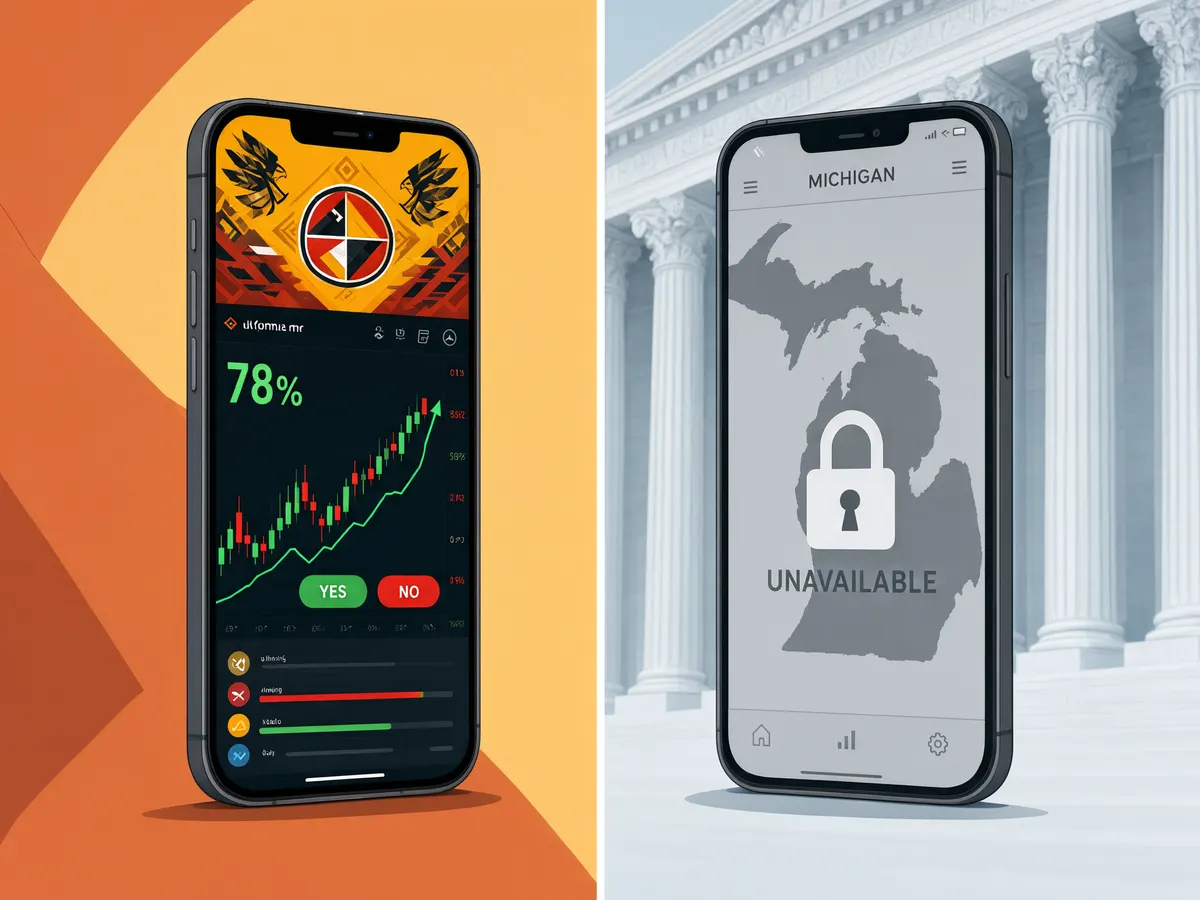
A sports trader in Grand Rapids opens Coinbase, goes looking for this weekend’s NFL markets, and finds nothing. Same week, roughly 1,200 miles southwest, a tribal town in Oklahoma is preparing to put its own name on a prediction-market app. Two companies, two opposite reads of the same legal fog.
That contrast is the story. Kalshi’s tribal partnerships push deeper into contested ground while Coinbase quietly retreats from a state that told it to stop. Both are rational responses to the same problem: nobody can say with certainty whether sports event contracts are legal in a given US state right now, and the answer may not arrive until the Supreme Court decides whether to weigh in.
What Kalshi actually signed
Four Native American tribes have agreed to launch prediction-market apps with Kalshi: the Alabama-Quassarte Tribal Town in Oklahoma, plus three California tribes, Greenville Rancheria, Kletsel Dehe Wintun Nation and Alturas Indian Rancheria.
The structure matters more than the headcount. Each tribe owns its customer-facing platform and controls the branding, the marketing and the customer relationship. Kalshi supplies what it is good at, the trading infrastructure and the liquidity. In practical terms the tribe gets a consumer business without building an exchange, and Kalshi gets distribution plus a partner whose sovereignty is a legal asset rather than a liability.
It follows a similar deal Kalshi struck with a Louisiana tribe in September. So this is not a one-off experiment, it reads like a repeatable template for Kalshi expansion, and it lands in the middle of a fight. Many tribal gaming organisations are suing Kalshi over exactly these sports event contracts, arguing they amount to unlicensed sports betting that undercuts compacts and tribal exclusivity. Four tribes just decided they would rather hold the rod than argue about the river.
Why Coinbase did the opposite
Coinbase agreed to stop offering sports event contracts in Michigan after pressure from state regulators. No lawsuit, no injunction fight, no principled stand. It switched the market off for Michigan users and moved on.
The asymmetry in incentives explains it. For Kalshi, event contracts are the business. Lose the legal argument and the company’s core product shrinks to politics, economics and weather. For Coinbase, sports markets are one line item beside a crypto exchange that already lives under the scrutiny of the SEC, state money-transmitter regimes and banking partners. Trading a licence problem in Michigan for a few weeks of NFL volume would be a terrible deal.
So the Coinbase Michigan exit is not a verdict on whether event contracts are lawful. It is a company with more to lose choosing the cheap option.
Who regulates what, in plain terms
The confusion in this whole area comes from three separate legal systems claiming the same activity. Here is the short version.
| Route | Primary regulator | Legal basis | Where it operates | Main vulnerability |
|---|---|---|---|---|
| Federal event contracts (Kalshi-style) | CFTC | Commodity Exchange Act, designated contract market rules | Nationwide, in principle | States arguing the contracts are really sports betting |
| Licensed online sportsbook | State gaming regulator | State statute and licence conditions | Only states that have legalised it | Tax and compliance costs, state-by-state rollout |
| Tribal gaming | Tribe plus NIGC oversight | Indian Gaming Regulatory Act and tribal-state compacts | Generally tied to tribal lands and compact terms | Compact limits, disputes over off-reservation and online reach |
Event contract legality in the US hinges on a definitional question. If a “will Team A win” contract is a swap traded on a federally designated exchange, the CFTC regime arguably preempts state gambling law. If it is a wager dressed in financial language, state law and tribal compacts should govern it. Courts have not settled that, and regulators in several states have told operators to stop in the meantime.
The case that decides it
Thirty-nine states and Washington, D.C. are urging the Supreme Court to review a ruling that went Kalshi’s way in New Jersey. That is an unusually broad coalition, and it tells you how states read the stakes: if federal preemption holds, every state that spent years building a licensing and tax regime for sports betting watches a parallel market open outside it, paying no gaming tax and following none of its rules.
Until the court acts, the map stays patchy. Prediction market regulation is being written in injunctions, cease-and-desist letters and settlements rather than statutes, which is why the same product can be live in one state and dark in the next.
The verdict: which approach ages better
On a two-year view, Kalshi’s tribal gaming deals are the stronger play, with a real tail risk attached.
The upside is that sovereignty gives Kalshi a second legal argument. If federal preemption weakens, a tribally owned platform can still point to IGRA and its own regulatory authority. The deals also split the opposition. A united tribal front suing Kalshi was one of the more persuasive political obstacles it faced, and four tribes with revenue on the other side of the ledger makes that front look less united. Meanwhile the tribes get a digital product without the capital cost of building an exchange or waiting for a state to legalise online betting.
The risk is concentration. Kalshi is betting the company on one reading of the Commodity Exchange Act. An adverse Supreme Court outcome does not just cost it New Jersey, it puts the entire sports vertical, tribal-branded apps included, into question at once. And tribal partners taking branding and customer relationships inherit reputational exposure if regulators later call the product unlicensed gambling.
Coinbase’s approach is lower variance and lower ceiling. It keeps optionality, protects the licences that matter to its main business, and can switch Michigan back on in a day if the law clarifies in its favour. It also concedes ground every time a state pushes, which means its event-contract footprint will shrink to whatever regulators tolerate rather than whatever the law eventually allows.
Different companies, both choosing correctly for their own balance sheets. That is the honest read.
What it changes for people actually trading these markets
Three practical points if you use prediction markets on sport.
- Availability is now a state-level question, not a product question. Expect more markets to vanish from apps with little notice, as Michigan users saw. Keep balances where you can withdraw them.
- Consumer protections differ from a licensed sportsbook. A CFTC-regulated exchange and a state-licensed sportsbook have different complaint routes, different dispute rules and different responsible-gambling mandates. Check which one you are dealing with before you fund an account.
- The economics are still the economics. Whether you are paying a bookmaker’s margin or an exchange’s spread and fees, the cost of trading is real and it compounds against you. Event contracts on sport carry the same risk of loss as any wager, no matter how the paperwork describes them. Set deposit and loss limits, use the exchange’s own tools, and treat the money as spend rather than income. If it stops being entertainment, step away and use the self-exclusion options available to you.
Two things readers keep asking
Are Kalshi’s tribal apps legal everywhere? Not settled. They operate on Kalshi’s federal exchange argument, which several states dispute and which the Supreme Court has been asked to review. Availability will depend on where regulators and courts land, state by state.
Does Coinbase leaving Michigan mean prediction markets are banned there? No. It means one operator agreed to stop offering sports event contracts in that state after regulatory pressure. Non-sports markets and other operators sit under separate arguments and separate enforcement decisions.