Does it matter to anyone outside a boardroom that a stock index named after a trade association slipped 6 percent last month? For your next session on a slot, no. For the kind of cabinets, mechanics and bonus features that will be on casino floors in two years, a little. The AGEM Index is one of the few regular, public read-outs of how investors feel about the companies that actually build gambling products, and in September 2026 that read-out turned negative for the first time since March.
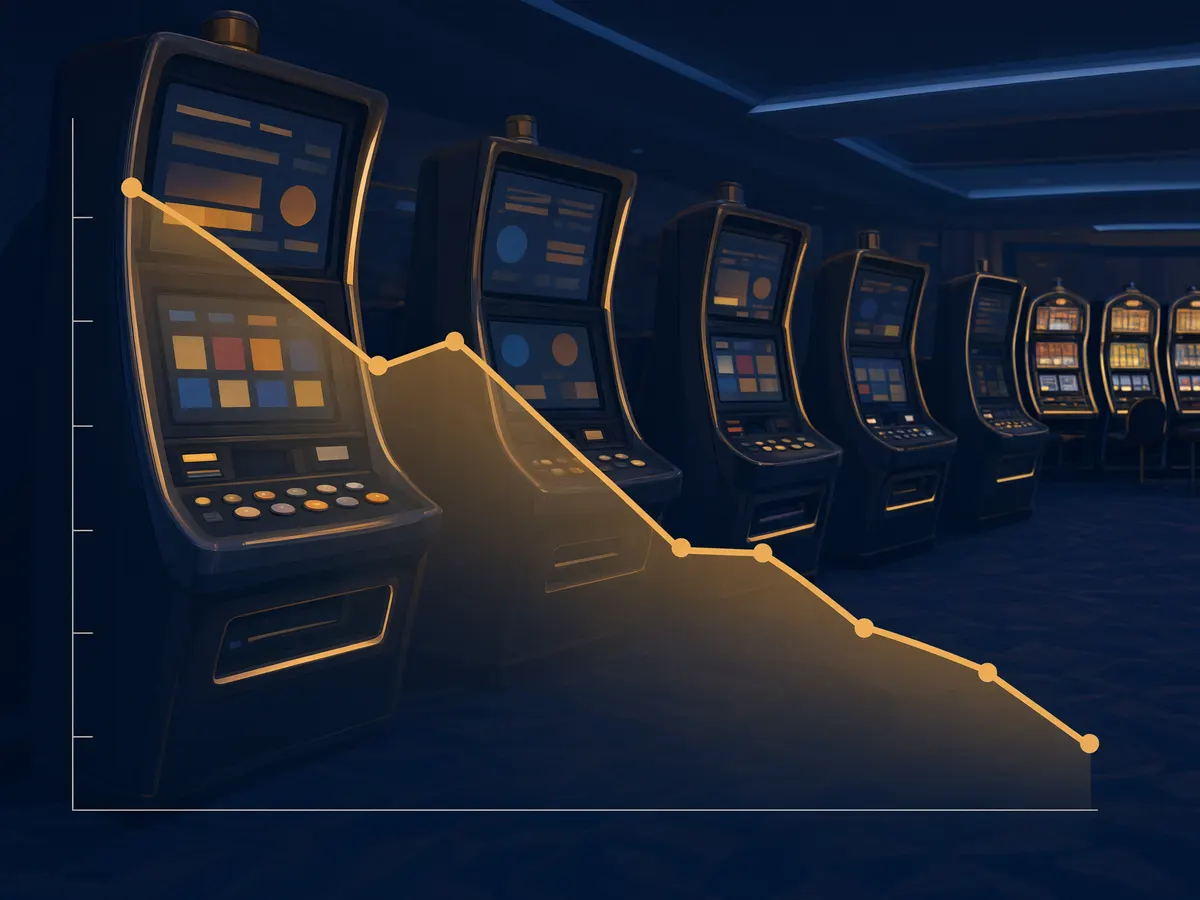
The number: the AGEM Index fell 118.24 points to 1,811.01, a 6.1 percent decline from the prior month. Measured against the same point a year earlier, it was down 5.9 percent, or 114.20 points. Eight of the nine companies in the index posted share price declines, and the index recorded nine negative contributions and zero positive ones.
What the AGEM Index actually tracks
The AGEM Index is a monthly composite of share prices from publicly traded gaming supplier companies, published by the Association of Gaming Equipment Manufacturers. These are the businesses behind slot cabinets, game content, lottery systems, sports betting platforms and casino management software, not the operators who run the casinos themselves. AGEM maintains the methodology and the historical series on its own index page.
Two things follow from that design. First, it is a sentiment gauge, not a revenue figure. It moves when investors reprice these companies, which can happen on earnings, on regulation, on a single executive announcement, or on nothing more than a broad market wobble. Second, it is a small basket. Nine companies means one large constituent having a bad month can drag the whole reading down, which is exactly what happened in September.
What pulled the index down
The biggest single drag was Aristocrat Leisure Limited. Its share price fell only 2.3 percent, but because of its weight in the basket that translated into a 46.60-point loss for the index. The more dramatic individual move came from Light & Wonder, down 16.8 percent on the month, which knocked 39.12 points off the index. The same month brought a management change at the company: on 17 September 2026, Light & Wonder announced that Josh Wilson, chief executive of its social casino business SciPlay, would step down effective 30 October 2026.
It is worth sitting with that pairing for a second, because it explains how the index behaves. A modest 2.3 percent move in the heaviest constituent did more damage than a 16.8 percent collapse in a smaller one. If you read the headline percentage without looking at the contributor breakdown, you will misread the story.
| Contributor | Share price move | Index impact |
|---|---|---|
| Aristocrat Leisure Limited | −2.3% | −46.60 points |
| Light & Wonder | −16.8% | −39.12 points |
How much of this was the market, and how much was gaming?
Some of it was simply a weak month for equities, but not all of it. Of the three major US indices, two fell: the Dow Jones Industrial Average dropped 4.3 percent and the S&P 500 slipped 0.5 percent, while the NASDAQ rose 1.9 percent. Against that mixed backdrop, a 6.1 percent fall in gaming suppliers looks sector specific rather than a pure market effect.
| Index | September 2026 move |
|---|---|
| AGEM Index | −6.1% |
| Dow Jones Industrial Average | −4.3% |
| S&P 500 | −0.5% |
| NASDAQ | +1.9% |
The breadth figure reinforces that. When eight of nine constituents fall in the same month and nothing in the basket contributes positively, you are not looking at one company’s problem. You are looking at investors marking down the whole supplier group.
Why equipment maker sentiment reaches the games you play
Nothing on a casino floor changes because an index moved in September. The link is slower and runs through budgets.
Gaming suppliers spend heavily on game studios, mathematics teams, cabinet hardware and regulatory approvals in each jurisdiction. A single new slot can take a year or more from concept to a licensed, field-tested product. When supplier valuations are under pressure for a sustained stretch, the usual consequences are fewer speculative game launches, longer cabinet refresh cycles, more sequels to proven titles, and consolidation as larger firms absorb smaller studios. The practical result for players, if a downturn persists, is less novelty on the floor and in the lobby: more follow-ups to hits that already work, fewer experimental mechanics.
The reverse is also true, and it is the more common pattern. Confident suppliers fund risk. Several of the mechanics that now feel standard, from Megaways style variable ways-to-win to hold-and-spin bonus rounds, came out of periods when studios had room to gamble on an unproven idea.
What the index does not tell you is anything about the games themselves. RTP, volatility and hit frequency are set in a game’s maths model and verified by testing labs before a title goes live. A supplier’s share price has no bearing on the RNG behind a spin, and no month of index data says anything about whether a particular game pays better or worse. The house edge is built into the maths, not into the stock chart.
Reading the index without overreacting
One month is not a trend, and this is a small index with concentrated weightings. A sensible way to handle a reading like September’s:
- Check breadth before the headline number. Eight of nine falling is a different signal from one heavyweight dropping alone.
- Look at the year-over-year line. Down 5.9 percent on the year is the more meaningful figure than a single month’s 6.1 percent.
- Separate company news from sector news. A chief executive departure at SciPlay is a governance story at one business, not evidence that demand for slot cabinets is falling.
- Compare against broad markets. The Dow was down too. Strip that out and the sector-specific part of the move shrinks.
- Wait for the next two readings. This was the first monthly decline since March. The series spent most of the year rising, and whether September broke that pattern or just interrupted it will be clear by the winter.
The useful takeaway from September is narrow and worth keeping narrow: investor confidence in gaming suppliers cooled, concentrated in two names, in a month when the wider US market was also soft. If the index keeps sliding into the new year, the knock-on effects will eventually show up in release schedules and trade show floor plans. If it does not, September will read as a single bad month in a series that has had plenty of them.
And none of it is a signal about your own play. Industry data describes the business of gambling, not the odds of any individual session, which remain what the game’s maths says they are. If you gamble, set deposit and time limits before you start and use the operator’s self-exclusion and reality check tools if play stops being entertainment.