Ever wondered why the casino host knows your name but the hotel desk doesn’t?
That gap is the whole argument for unified resort operations. You can be a tracked, carded player who gets a personal call about a slot tournament, then walk to the front desk and be treated as a stranger with no booking history, no dining preference, and no record that you just dropped four hours on the floor. The resort knows you three or four times over, in three or four different databases, and none of them are talking.
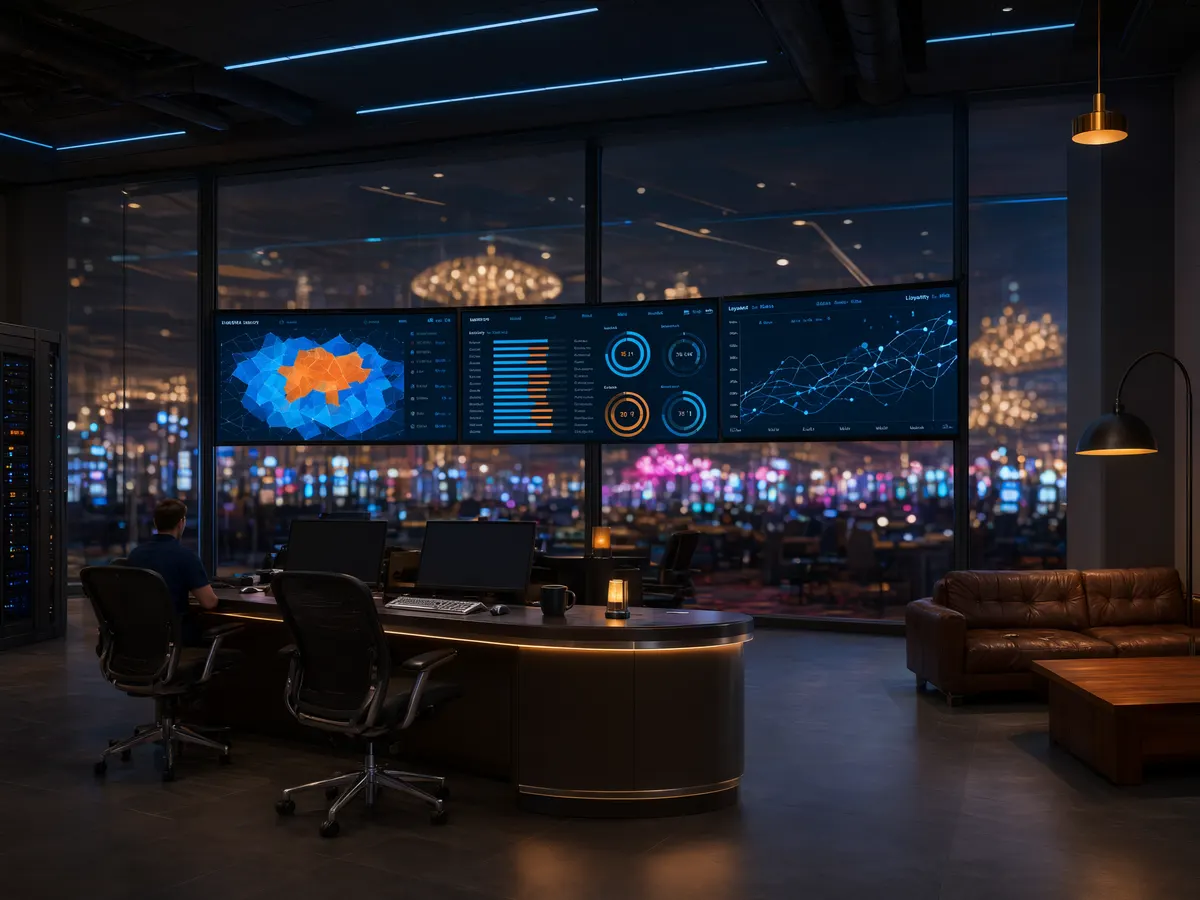
Quick Custom Intelligence (QCI) built its Global Gaming Expo appearance around closing that gap. The company exhibited at G2E 2026, held 28 September to 1 October at The Venetian Expo in Las Vegas, with QCI Resorts as the centrepiece: a platform that pulls hospitality, food and beverage, marketing, loyalty, guest engagement and enterprise operations into one shared working environment, with gaming systems integrated where a property needs them. QCI also expanded the capabilities of QCI Metrics, its analytics layer, and ran live demonstrations on the floor alongside a branded RV activation it had announced ahead of the show.
That’s the news. The more interesting question is what it actually changes.
What does “unified resort operations” mean in practice?
It means one operational picture of a property instead of several partial ones. Today a typical integrated resort runs a casino management system for the gaming floor, a property management system for rooms, a point-of-sale system for restaurants and bars, a separate marketing or CRM tool, and often a loyalty engine bolted to the side. Each does its job. Each holds a slice of the same guest.
Unified resort operations is the attempt to make those slices legible to each other in real time, so a decision made in marketing is visible to the host on the floor, and a room availability constraint is visible to the person about to offer a comped night.
Worth being precise about one thing in QCI’s positioning: this is not sold as ripping out the gaming floor system. The gaming stack is integrated “where required” rather than replaced. That’s a practical choice. Slot accounting and ticketing are regulated, certified, and deeply embedded; nobody swaps them out casually. The unification happens in the layer above.
Where the data sits now, and what shifts
| System layer | What it traditionally owns | What unification changes |
|---|---|---|
| Casino management system | Carded play, slot accounting, player ratings, floor performance | Stays in place; feeds play data into a shared view rather than living alone |
| Property management system | Room inventory, rates, reservations, stay history | Room decisions can be weighed against a guest’s actual gaming and spend profile |
| Point of sale | Restaurant, bar and retail transactions | Non-gaming spend becomes part of guest value, not a separate ledger |
| Marketing and CRM | Campaigns, offer lists, direct mail and email | Offers can be checked against live capacity and recent behaviour before they go out |
| Loyalty platform | Tier status, points, comp balances | Earning and redemption reflect the whole property, not mainly the floor |
Why were casino systems ever this fragmented?
Because they grew up separately, and for good reasons at the time. The casino management system exists primarily to satisfy regulators and accountants: every credit in, every ticket out, auditable. Hotel software grew out of hospitality, where the unit of value is a room night. Restaurant POS grew out of restaurants. Each vendor optimised for its own domain, and most properties bought the best available option in each category across a couple of decades.
The result is a stack held together by nightly batch files and a lot of human effort. Analysts export, reconcile, and rebuild the same guest picture by hand, often on a day’s lag. Anyone who has worked a casino marketing department recognises the Tuesday-morning spreadsheet ritual.
The shift that G2E 2026 reflected is that the integration problem has become the product. Casino operator technology is increasingly sold on how well it connects to everything else, not just on what it does in isolation. QCI’s framing of a shared operational environment is one expression of that; it is not the only vendor pushing in this direction, and the trade show floor has been drifting this way for several cycles.
What does it change for the operator?
Mostly speed and coordination, which sounds modest until you think about how a resort actually loses money. A comped room given to a guest whose recent spend has collapsed. A promotional mailer that lands on a sold-out weekend. A high-value guest walking out of a restaurant queue because nobody at the host desk knew they were waiting. None of those are dramatic failures. They are small leaks, repeated thousands of times a year.
A unified view attacks those leaks in a few concrete ways:
- Offer decisions get a fuller input. Reinvestment can be judged against total guest worth, including food, beverage and rooms, rather than carded gaming alone.
- Capacity and marketing stop fighting. If the hotel is full, the system knows before the campaign ships.
- Floor staff work from the same facts. Hosts, hotel staff and F&B managers seeing one record reduces the “let me check with someone” shuffle.
- Analytics move closer to real time. QCI’s expansion of QCI Metrics points at this: reporting that informs a decision today rather than describing last week.
A caution on expectations. Press releases from trade shows describe capability, not results. QCI’s G2E announcement did not publish customer counts, deployment figures, or measured revenue impact, and anyone evaluating a platform like this should ask for those numbers directly, property by property. Integration projects in gaming have a long history of running longer and costing more than the demo suggests, largely because the underlying data is messier than anyone admits until migration starts.
Does any of this matter if you’re the one playing?
Some of it, yes, and in both directions.
The upside is friction removal. Player loyalty platforms that genuinely span a property mean points and tier credit that reflect what you actually spent, dinner included, rather than only what you put through a slot machine. It means the front desk having your stay preferences, the host knowing you booked the show, and comp offers that match what you use instead of what the property wants to push. If you have ever been told your dining spend “doesn’t count towards tier”, that is a systems boundary, not a policy of nature.
The honest counterweight: better data about guests is better data about guests. A unified profile is a more complete behavioural record, built to make marketing more effective at getting you to come back and spend. That is what the technology is for, and operators are open about it. Nothing in a unified stack changes the mathematics of the games themselves. House edge is set by game rules and paytables, not by software architecture, and a 2.7% edge on European roulette or a 4% edge on a 96% RTP slot is identical whether the property runs five systems or one.
There is a genuinely constructive use of the same plumbing, though. Connected data makes it far easier to spot patterns that should concern an operator: escalating session length, chasing behaviour, spend that breaks sharply from a guest’s own history. Jurisdictions with player protection obligations increasingly expect operators to act on exactly those signals. Whether unified platforms get used that way, rather than only for reinvestment targeting, is a fair thing to ask vendors and regulators alike.
What should you watch from here?
Three things, if you follow this corner of the industry.
First, whether integration depth is real or cosmetic. A shared dashboard reading from nightly exports is not the same as systems operating on live shared data, and marketing language rarely distinguishes the two. Ask what updates in seconds and what updates overnight.
Second, whether mid-size and tribal properties adopt it. Large Las Vegas operators have in-house engineering teams and custom stacks. The commercial case for a platform like QCI Resorts is strongest at properties that cannot build their own, and that is where adoption numbers will tell the story.
Third, what the regulated gaming layer does. As long as the casino management system stays separate and certified, “unified” means unified above the floor. That is a reasonable architecture, but it is a boundary worth remembering when the word unified gets used loosely.
QCI’s G2E 2026 appearance was a vendor making its case at the industry’s biggest annual gathering, and the case is a sensible one: a resort that behaves like a single business tends to serve guests better than a resort behaving like five businesses sharing a car park. The proof will be in deployments, not demonstrations.
If you gamble, treat it as paid entertainment with a built-in house edge and nothing more. Set deposit, loss and time limits before you start, and use the self-exclusion and cool-off tools your operator is required to offer if play stops feeling like a choice.